World leaders made a promise to fix almost everything by 2030—poverty, hunger, health, education, climate, you name it. The UN Sustainable Development Goals list 169 targets. It sounds noble. But it has been ten years since the Goals were set, and we’re not even close. It’s like promising to solve every problem in your house at once—roof, plumbing, wiring, garden—of course you’ll end up with nothing finished.
The truth is simple: we have limited money, limited time, limited political will. So we have to ask the hard question: What should we do first?
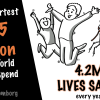
Together with more than a hundred top economists, we’ve used rigorous cost-benefit analysis to answer that question. We looked across all the big promises and asked: Where can an additional dollar do the most good? The result is twelve smart policies. They cost about $35 billion a year—less than just the world’s increased spending on cosmetics from 2020-23. For that money, we can save 4.2 million lives every year and generate more than $1.1 trillion in extra social and economic benefits, mostly for the poorest half of the planet.
This isn’t about doing less. It’s about doing the best things first.
Let me walk you through a few of the strongest ideas.
Start with tuberculosis. It still kills about 1.6 million people a year, mostly in poorer countries. We know exactly how to find more cases early and get people the treatment they need. For around $6 billion extra each year, we could save roughly a million lives annually. The social benefits—lives saved, families kept together, productivity—come back at about $46 for every dollar spent. It’s like discovering a hidden room full of treasure behind a door we already know how to open.
Malaria is next. Mosquitoes carry death across much of Africa. Simple, proven tools—bed nets, indoor spraying, medications—can cut deaths dramatically. About $5 billion a year could cut malaria mortality by a third and save around 200,000 children’s lives each year. Returns around $48 per dollar. Imagine handing every at-risk family an invisible shield that actually works.
Then maternal and newborn health. In many places, basic care around birth—emergency resuscitation masks and trained attendants—makes the difference between life and death. Five billion dollars could prevent about 166,000 maternal deaths and 1.2 million newborn deaths annually. Benefits are $87 per dollar. “Benefits are $87 per dollar. It’s like replacing a newborn’s first precarious tightrope with a wide, solid bridge.
Education is another standout. Forget just building more schools. The real game-changer is helping kids in primary school learn more by putting them in front of tablets with educational software, and helping teachers do better with structured teacher-plans in low-income areas. For roughly $10 billion a year, a third of a billion children gain learning equivalent to several extra years of school. Returns around $65 per dollar. It’s the difference between pedaling a rusty bicycle and riding a rocket.
Land tenure security matters enormously. When people don’t have clear, legal title to their land, they can’t borrow against it, and they don’t dare invest or improve it. Low-cost digital mapping and registration along with enforcement and administration would cost about $1.8 billion a year, but it could —could secure titles for over 200 million households in poorer Africa. Benefits are between $18 and $30 dollars per dollar spent. It’s like handing someone the key to their own car so they can finally drive.
Trade barriers hurt the poor most. Removing them would have some costs in rich countries, but even there, the benefits outweigh the costs 7-to-one. Removing trade barriers for poorer countries has few costs but delivers enormous gains—every dollar in trade loss is offset by an phenomenal $95 of benefits. Tariffs are walls in a river; take them down and wealth flows.
And e-procurement—moving government purchasing online—cuts corruption and waste. Savings of 6–13% on trillions in spending add up fast. It’s shining a digital spotlight that leaves corruption no place to hide.
These aren’t just theories. They’re working around the world. In Kenya, structured teaching has already turned around failing classrooms. In Rwanda, better land titles let farmers invest—and yields rose.
Why don’t we do more of this? Politicians often love grand gestures. They want to look good on television. But the evidence shows that flashy, expensive approaches—like cutting ribbons on gleaming new hospitals that lack doctors, dropping laptops into classrooms without lesson plans, or hosting grand summits to ‘end’ poverty—deliver far less or nothing per dollar spent. Of course, we all want to do all good things, but we have to start where we can do the most good first. It’s about handling the flood before you fix the roof leak.
Imagine redirecting just a fraction of existing aid and development spending—$35 billion out of hundreds of billions—toward these twelve priorities. We could save millions of lives and make the world dramatically better for billions of people.
We don’t need more promises. We need smarter priorities.
Let’s do the best things first!