
Maximum Entropy Production & Sustainability: Why the Drive to Maximize Energy Flow Explains Degrowth’s Struggle
In his 2025 book Energy, the flip side of money, Pierre Noizat delivers a provocative insight: the laws of thermodynamics don’t just govern heat engines—they shape human societies, economies, and our quest for sustainability.
At the heart of his argument is what he calls the “third principle of thermodynamics” (distinct from the classical third law about absolute zero). Better known in scientific literature as the Maximum Entropy Production Principle (MEPP), it states that dissipative structures—open systems far from equilibrium, like living organisms, ecosystems, hurricanes, or civilizations—self-organize to maximize the rate of energy throughput and entropy production under given constraints.
From bacteria optimizing nutrient gradients to economies scaling GDP, systems evolve toward configurations that dissipate available energy gradients as rapidly and effectively as possible. This isn’t malice; it’s physics at work.
Why This Matters for Sustainability
Traditional sustainability frameworks, like the Framework for Strategic Sustainable Development (FSSD/The Natural Step), rest on the first and second laws plus matter conservation: avoid systematic accumulation of substances from the Earth’s crust, synthetic chemicals, ecosystem degradation, and barriers to meeting human needs.
But MEPP adds a deeper layer: living and social systems aren’t passive. They actively seek to capture and dissipate more energy. This drive explains the relentless push for extraction, consumption, and complexity—even when it breaches planetary boundaries.
Noizat elegantly bridges physics and psychology by noting that humans directly feel entropy: we experience high entropy as anxiety or chaos when information is scarce or security is uncertain, while trustworthy knowledge and stable systems lower our internal entropy, fostering clarity and well-being. He connects this insight to money itself — a claim on future energy flows — and to Bitcoin, which converts real-world energy into verifiable, low-entropy information. This human-scale perception, he argues, is why sound money and energy-backed protocols like Bitcoin can meaningfully reduce societal disorder and help align economic self-organization with long-term sustainability.
It also sheds light on why pure degrowth strategies often falter politically and culturally. Contraction fights a fundamental gradient: systems “want” to maximize power and entropy export. Blind restraint feels like swimming upstream against biology, evolution, and economics.
Is Collapse Inevitable?
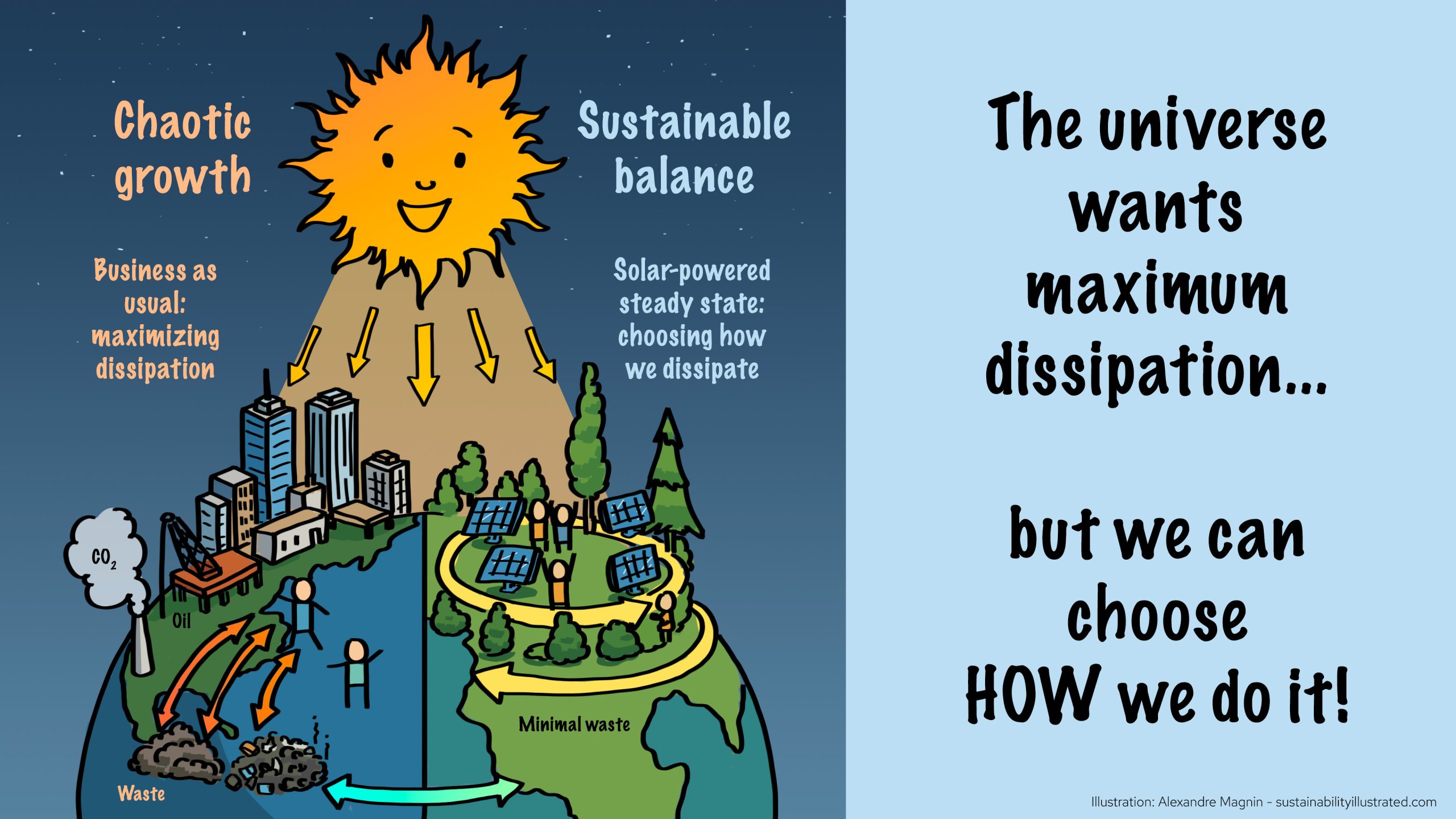
Not necessarily. Earth is an open system bathed in low-entropy solar radiation (~1.7 × 10¹⁷ W). Life has maximized capture for billions of years without tipping into total chaos: it reached dynamic steady states (climax ecosystems) where throughput aligns with the incoming budget.
We can do the same. The key is redirection, not denial:
- Shift dissipation from fossil/mined gradients to solar/biomass cycles.
- Design circular economies powered by abundant clean energy (near-closed material loops are feasible with enough input work).
- Use human agency—information, incentives, institutions—to steer self-organization toward longevity, efficiency, and well-being over raw throughput.
Social factors like trust, knowledge-sharing, win-win partnerships, and respect for nature reduce wasteful entropy production. But they’re amplifiers for structural change: carbon pricing, regenerative finance, proof-of-energy mechanisms, and metrics beyond GDP.
Physics isn’t fatalistic. The same laws driving maximization also enable balance via the Sun’s subsidy. We choose which gradients to exploit.
Final Thoughts
Noizat’s lens is sobering: sustainability isn’t just ethics or policy—it’s a thermodynamic engineering problem. Ignoring MEPP dooms us to repeated overshoot. Embracing it lets us harness the drive for abundance within limits.
If we get incentives and technology right, humanity can build a high-civilization, solar-powered steady state. Ignore it, and the dissipative urge accelerates the crises we already feel.
What do you think—can we redirect this fundamental principle, or is endless maximization our destiny? I’d love to hear your take in the comments.
References
📙 – **Noizat, P.** (2025). *Energy, the flip side of money*. Konsensus Network. (ISBN 978-9916749630)
– **Broman, G. I., & Robèrt, K.-H.** (2017). A framework for strategic sustainable development. *Journal of Cleaner Production*, 140, 17–31.
– **Kleidon, A.** (2010). Maximum entropy production in environmental and ecological systems. *Philosophical Transactions of the Royal Society B: Biological Sciences*, 365(1545), 1297–1302. https://doi.org/10.1098/rstb.2009.0318
– **Kleidon, A.** (2023). A review of thermodynamics and optimality of the Earth system. *Earth System Dynamics*, 14(4), 861–887. https://doi.org/10.5194/esd-14-861-2023
– **Martyushev, L. M., & Seleznev, V. D.** (2006). Maximum entropy production principle in physics, chemistry and biology. *Physics Reports*, 426(1), 1–45. https://doi.org/10.1016/j.physrep.2005.12.001
– **Odum, H. T.** (2004). The continuing importance of maximum power. In C. A. S. Hall (Ed.), *Maximum power: The ideas and applications of H. T. Odum* (pp. 1–10). University Press of Colorado. (Original work related to Odum’s Maximum Power Principle, 1955/1971)
– **The Natural Step.** (n.d.). The system conditions. Retrieved March 24, 2026, from https://thenaturalstep.org/approach/the-system-conditions/
– **Volk, T.** (2010). It is not the entropy you produce, rather, how you produce it. *Philosophical Transactions of the Royal Society B: Biological Sciences*, 365(1545), 1317–1322. https://doi.org/10.1098/rstb.2009.0319
Visit our blog, all videos on sustainability and contact us for more.






Hi Alex, I just sent you an email about this important post! Thank-you for highlighting this critical topic. Not sure I concur with all your conclusions – but directionally I think you’re heading in a useful direction. And glad to see you citing Alex Kleidon – his work to apply MEPP to understanding the Earth’s climate is, I believe, really important. I look forward to your reply to my email. Flourishing felicitations, Antony
Thanks Antony! I’m glad this resonated with you 🙂
A reflection….
MEPP as a missing layer in sustainability thinking is a genuinely powerful framing. Most green frameworks treat humans as rational agents who just need better rules. Noizat’s point that systems structurally push toward maximum dissipation, explains why good intentions keep losing to growth imperatives.
The solar steady-state argument is solid too. Earth’s biosphere already proves you can maximize entropy production sustainably if your energy source is the sun. Climax ecosystems are the proof of concept.
Maybe not so clear link
The Bitcoin connection is the weakest link. Claiming Bitcoin “reduces societal disorder” by converting energy into “low-entropy information” is a stretch. Bitcoin’s energy consumption is itself a textbook case of MEPP in action, a system maximizing dissipation. Calling it a sustainability tool requires ignoring that it currently accelerates exactly the fossil-gradient exploitation the rest of the argument warns against. The logic is circular: use MEPP to diagnose the problem, then celebrate a MEPP-maximizing system as the cure.
The “humans feel entropy as anxiety” claim is metaphorical, but not really physics. Entropy has a precise technical meaning. Mapping it onto psychological states sounds elegant but risks being unfalsifiable hand-waving. Shannon entropy, information, and thermodynamic entropy are related but not interchangeable with “felt experience.”
The degrowth critique is perhaps too quick. Saying contraction “fights a fundamental gradient” naturalizes current economic structures. Pre-industrial societies maintained steady states for millennia. The gradient-maximizing drive isn’t destiny, it’s one attractor among many, heavily shaped by institutional design. Dismissing degrowth as “swimming upstream” smuggles in a fatalism the author claims to reject.
The core tension the piece doesn’t resolve
If MEPP is truly fundamental, why would any system voluntarily redirect toward lower-throughput pathways? The article says “human agency” and “incentives”, but those are the same tools every sustainability framework already invokes. MEPP does not really add a new solution, but rather a sharper diagnosis.
Hi Katarina,
Thank you for your response. You can call me Alex, not “the author” 😀
I think the bitcoin energy consumption is misunderstood and definitely not a case of MEPP in my opinion. Thats’ why I posted the “Bitcoin energy consumption explained”: https://sustainabilityillustrated.com/en/portfolio/bitcoin-energy-consumption-mining-empowering-renewables/
Survival would be a major reason why a system would voluntarily redirect toward lower-throughput pathways and it would need to find other ways to reduce entropy thanks to knowledge and social connection as opposed to energy spending.